DeepSeek Harness vs Claude Code and Codex: What the Open AI Agent Can Do
A model provides reasoning, but intelligence alone cannot operate on a real codebase. An agent also needs a layer that supplies context and tools, controls file access, preserves sessions, and handles failures. That layer is the harness.
DeepSeek Harness is an open agent runtime built around an “everything is a plugin” architecture. It is currently a developer preview. It is already useful for experiments, but its APIs may change incompatibly, so calling it a guaranteed replacement for Claude Code or Codex would be premature.
The model is only one part of an agent
The same model can perform differently across agents because the system prompt, tools, context management, permission flow, and retry logic are different.
A practical harness collects relevant project files, exposes controlled editing and shell tools, limits the accessible workspace, preserves multi-step state, records actions, and lets the user stop or revert unwanted work. This is why meaningful evaluation should compare a complete “model + harness + task” combination rather than model names alone.
Everything is a plugin
DeepSeek Harness represents models, tools, skills, storage, interfaces, and agent loops as plugins. The Cordis kernel manages mounting and dependencies. A component can be replaced without rebuilding the entire agent.
That flexibility is useful for infrastructure developers. You can assemble a minimal agent, switch providers, or add a tool for an internal API. The trade-off is a larger supply-chain surface: third-party plugins require code review, dependency checks, and narrowly scoped permissions.
Working modes
The official documentation describes several modes. Standard provides a conventional coding-agent toolset. Minimal keeps only a shell and file editor, making model comparisons easier. Creator supports runtime inspection and custom configurations. Code Mode lets the model compose several tool calls programmatically.
Use Standard for ordinary project work, Minimal for controlled experiments, and Creator when you are developing the agent infrastructure itself.
Installation and safe first run
The quickest start requires Node.js:
npx @deepseek-ai/dsh web
To inspect and build the source:
git clone https://github.com/deepseek-ai/deepseek-harness.git
cd deepseek-harness
pnpm install
pnpm run build
pnpm dsh web
Begin in a disposable directory, not a production repository containing secrets. Do not expose .env files, SSH keys, or unrelated directories. Before installing a community plugin, inspect its code, permissions, dependencies, and maintenance history.
Observability is useful, not infallible
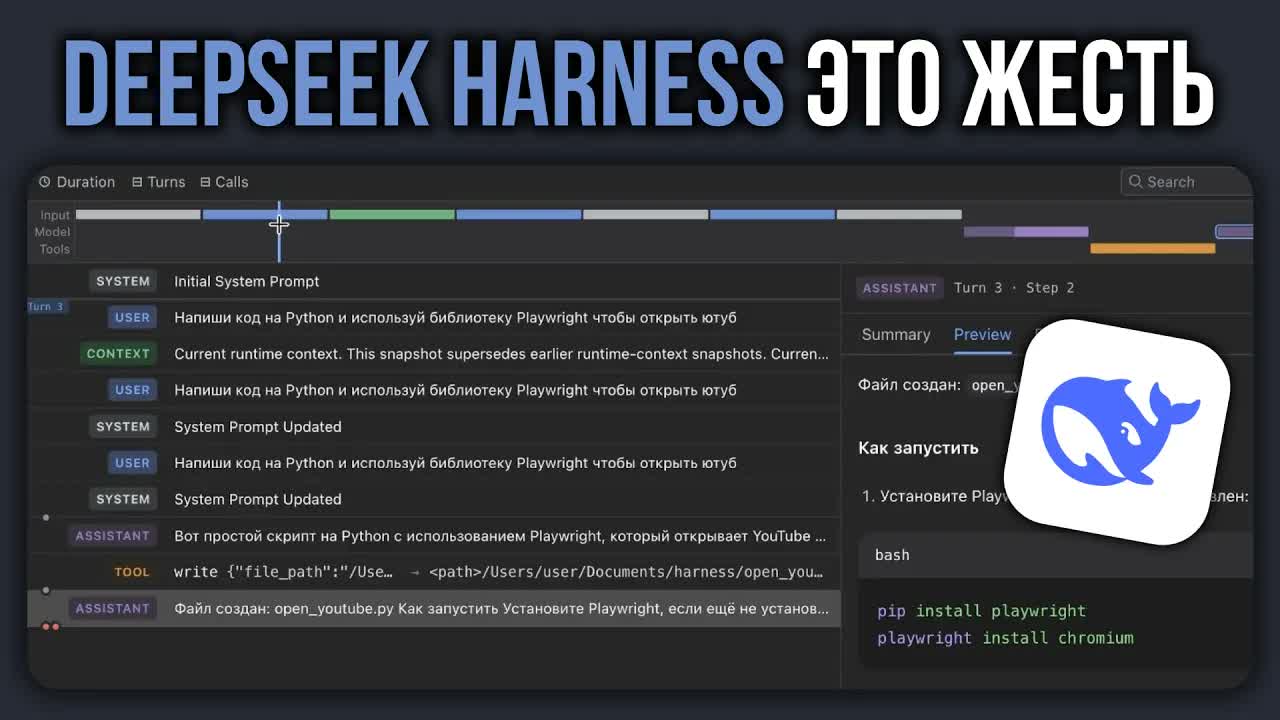
An open harness can expose tool calls, file edits, token usage, and session state. Those records make failures easier to diagnose and experiments easier to reproduce.
A detailed trace is not proof that the result is correct. A model can explain a bad action convincingly. Verify the outcome with tests, linters, a diff, and human review. For important work, use a separate branch or an isolated container.
How it compares with Claude Code and Codex
Claude Code and Codex offer a more integrated product experience and tight coupling with their model ecosystems. DeepSeek Harness prioritizes replaceable components and runtime experimentation.
Choose based on the actual constraint:
- for daily work, evaluate stability, edit quality, and workflow friction;
- for multiple providers and custom tools, an open plugin system offers more control;
- for a fair benchmark, keep the repository, task, tests, and permissions identical;
- for sensitive code, inspect where the selected provider sends and retains data.
What to understand before testing
The interesting part of DeepSeek Harness is not a claim that it will “kill” every other coding agent. It is the architecture: tools, interfaces, and loops can be composed as independent components. Today it is primarily a platform for developers and experiments. Treat the developer-preview label seriously, run it with isolation, and validate every change with ordinary engineering controls.
What I observed in a real run
Every agent looks similar in a demo: receive a task, edit files, show green tests. Differences appear when work no longer fits one prompt. Harness loops through planning, tool calls, verification, and the next step. It should therefore be evaluated not only by its model but by state handling, command boundaries, and recovery after failure.
I connected a provider, used an isolated directory, and traced every call. This exposed what a polished terminal hides: which files were read, how often search repeated, where the plan changed, and how many tokens an unsuccessful hypothesis consumed. Without observability, an intelligent loop and an expensive retry cycle look identical.
Thousands of plugins are both strength and risk
A plugin may add a tool, command, memory format, or service integration. That makes Harness more extensible than a closed client. It also executes with the process's permissions. If the process sees SSH keys, .env, and the Docker socket, a malicious extension sees them too.
I inspect source code, permissions, and network calls, then pin a version. “Install with one command” is convenience, not a security model. Unknown extensions belong inside a container, under a dedicated user, with minimal secrets and no production data.
Self-modification without magic
The agent can modify its own instructions and components, which looks like a system improving itself. Technically it is ordinary file editing where the target happens to be the harness. A bad patch has wider consequences because it affects every later task.
I keep configuration in Git, require a diff, and run tests after changes. Self-modification should behave like a pull request: a stated problem, minimal patch, test, and rollback. Unlogged self-editing is not intelligence; it is unreproducible configuration.
Comparing agents on one task
A fair test uses the same repository, model, prompt, and budget. I record success, number of calls, cost, diff size, repeated mistakes, and time to the first passing test. Claude Code may win on integrated experience, Codex on isolation and workflow, and Harness on openness and replaceable components. Change the model or task and the ranking changes.
A safe starting configuration
- Use a separate branch and clean working directory.
- Provide one test-provider key with a small spending limit.
- Block the home directory, Docker socket, and production SSH.
- Log commands, cost, and file changes.
- Start with a task covered by tests.
- Review the diff before expanding permissions.
This is less dramatic than granting full access and asking the agent to “do everything,” but a failure remains explainable and reproducible.
My conclusion after testing
DeepSeek Harness matters less as a free Claude Code clone than as a system where the model, tools, memory, and loop rules are replaceable. That is valuable when control is the requirement. For a small repository fix, a mature closed client may still be more convenient.
Openness raises the ceiling and moves responsibility to the operator. “Who won?” is therefore less useful than “which components and permissions does this task require?”
Related video: DeepSeek Harness — the end of Claude Code and Codex?