The Open-Source Fruit Fly Brain: How a Neural Behavior Model Works
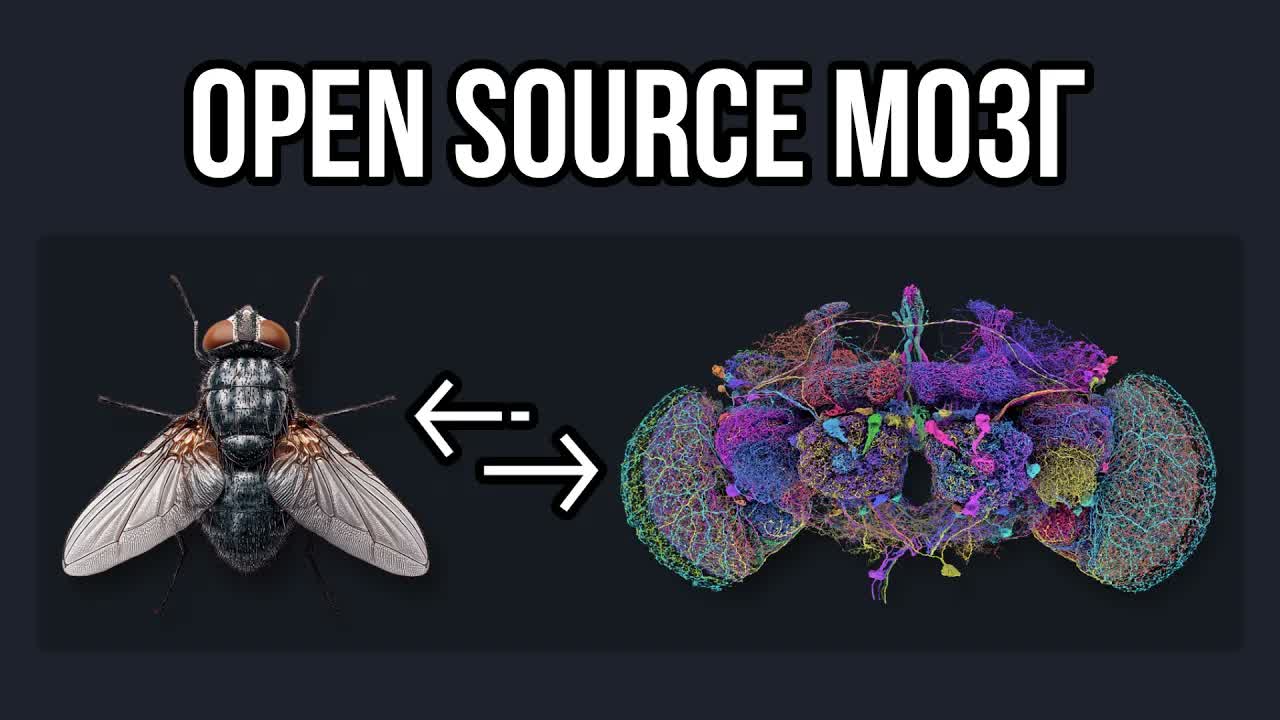
“Scientists uploaded a fly brain into a computer” sounds as if a digital insect became conscious. The real achievement is both more limited and more useful: researchers reconstructed a fruit fly brain’s wiring and can use it to test models of behavior.
Three things must remain separate: the anatomical map, a mathematical model of neural activity, and a virtual body. None of them is the fly’s personality.
What a connectome contains
A connectome is a map of neurons and their synaptic connections. In 2024, the FlyWire consortium published a wiring diagram of an adult female Drosophila melanogaster brain containing roughly 139,000 neurons and more than 50 million synaptic connections.
The source material came from electron microscopy. The brain was represented by thousands of extremely thin slices; algorithms reconstructed neurons, while researchers and community contributors corrected segmentation errors.
This is a remarkable engineering result, but a wiring diagram does not fully explain a working brain. Structure alone does not reveal every signal strength, cell state, or biochemical influence.
A wiring map is not a running mind
Imagine having a computer’s circuit diagram without exact component properties or its current execution state. The diagram explains architecture, but it does not reproduce a particular running session.
Likewise, a connectome shows possible paths for signals, not every parameter of a living organism. Behavioral simulation also needs models of neural dynamics, sensory inputs, motor outputs, and learning rules.
The accurate description is therefore a simulation grounded in fly-brain data—not a complete digital transfer of a living animal.
Why the model needs a body
A nervous system does not operate in isolation. It receives vision, smell, and body-state signals, then controls muscles. Without a body and environment, behavioral predictions cannot be tested.
A virtual body enables experiments: provide a stimulus, observe model activity, and compare the resulting motion with a real fly. Researchers can study walking, orientation, grooming, and obstacle responses without claiming that consciousness appeared inside the simulation.
What the model can and cannot do
It can help researchers test hypotheses about neuron groups, trace paths from sensation to motion, plan biological experiments, compare predicted and observed behavior, and explore efficient control systems for robotics.
It does not prove that memory, subjective experience, or the complete mind of a particular fly has been reproduced. Even a complete anatomical map does not automatically include every dynamic and chemical parameter.
Why open data matters
FlyWire is valuable not only because of its scale. Its data, exploration tools, and papers allow other researchers to verify claims, build alternative models, and connect results across experiments.
Openness also separates scientific results from viral interpretations. Anyone can inspect the neuron counts, reconstruction method, and stated limitations instead of trusting a headline about “uploaded consciousness.”
What we can conclude today
The digital fly is not an immortal insect living inside a computer. It is a research system that combines a connectome, mathematical dynamics, and a body model. Its importance is more concrete: a detailed whole-brain map can now help scientists test how network structure produces observable behavior.
Why the internet turned the research into a meme
People connected the virtual fly to absurd tasks: moving through Doom, choosing game actions, and even acting as an “agent” that fixes Docker. I also began with a playful integration because it makes the interface visible. But it produced a false conclusion—that scientists uploaded insect consciousness and it learned to use a computer.
There is an enormous gap between movement and understanding Docker. The model emits a control signal; external code maps it to “turn,” “press a key,” or select a predefined action. Meaning lives in the human-written adapter, not inside the fly.
What scientists reconstructed
Researchers built a connectome: a map of neurons and synaptic connections in the adult fruit-fly brain. Tissue is cut into extremely thin sections, imaged with electron microscopy, reconstructed into cell processes, and validated. One segmentation error along an axon can alter an entire pathway, so automatic reconstruction requires extensive human checking.
Connectivity alone does not specify behavior over time. Simulation also needs activity parameters, cell types, synaptic properties, and sensory input. Some values are measured; others are simplified. It is more accurate to describe models of particular sensorimotor circuits than a complete digital brain.
Why the model needs a body
Vision causes movement, movement changes the image, and the new image feeds back into the network. A virtual body closes that loop. The fly receives sensory data, neural circuits produce motor activity, and a physics engine converts it into joint movement.
Researchers do not hand-code every leg trajectory, yet the network and body may reproduce observed behavior. That does not demonstrate consciousness. It tests whether known wiring and chosen parameters can explain movement.
What strange experiments contribute
Swapping male and female components does not move a personality. It separates contributions from circuit structure, internal state, sensory input, and mechanics. A changed behavior becomes a testable hypothesis.
In simulation, thousands of connections can be disabled, the same input replayed, and the original state restored. Predictions then return to living animals for validation. Control and repeatability—not a viral video—create scientific value.
I separate demos from results by asking whether data is open, which parameters are measured, what behavior validates the model, and whether another team can reproduce it. A Doom video demonstrates integration. A documented comparison produces evidence.
A map of the model's limits
| What is known | What does not follow |
|---|---|
| Neuron geometry and many connections | The exact state of every cell at a given moment |
| Several cell types and signal directions | Complete chemical dynamics of the organism |
| Reproduction of selected movements | Consciousness, memory, or a particular fly's personality |
| Control of an external program | Understanding the program's meaning |
This distinction applies beyond neuroscience. Every AI project should separate data, model, interface, and interpretation. When an adapter turns a signal into an action, understanding cannot automatically be attributed to the source. Behavioral similarity also does not reveal the internal mechanism.
Limits do not reduce the achievement. A useful scientific model must be narrow enough to be falsified. “We created a digital personality” is exciting and nearly impossible to test. “This circuit predicts this trajectory under this stimulus” is less dramatic and far more useful.
Related video: The open-source fruit fly brain