Why a Python List Can Consume All Your Memory—and How to Prevent It
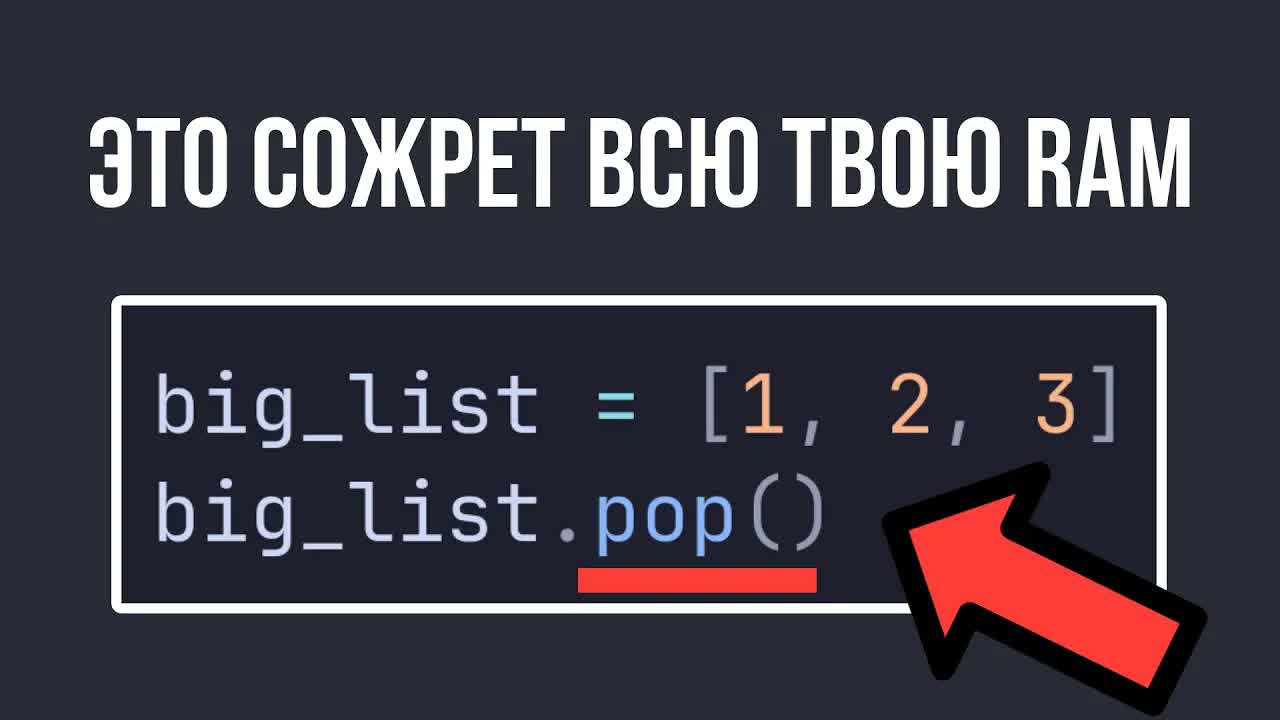
Two Python lists with identical contents can occupy different amounts of memory. This is not a mysterious leak: a list stores references to objects and normally allocates more slots than it currently needs. That spare capacity makes append efficient, but at scale a poor algorithm can turn the optimization into gigabytes of avoidable memory use.
Why lists keep spare capacity
If an array grew by exactly one slot, every append could require a new block and a copy of all references. CPython grows capacity in chunks. Consequently, sys.getsizeof() may differ for lists of the same length when one was constructed at once and the other went through repeated resizing.
Removing an item does not guarantee that memory immediately returns to the operating system. The list has internal capacity, and the process allocator may retain blocks for reuse. This differs from a genuine leak, where live references prevent objects from being reclaimed.
How one line can consume all RAM
The dangerous patterns materialize a huge sequence at once: list(range(...)), reading a large file with read(), collecting every database row, or appending forever to one global list. Even when each item appears small, the list stores millions of references and the referenced objects consume additional memory.
Measure the process, not only the container. sys.getsizeof() does not recursively include every nested object. Use tracemalloc, resident-memory metrics, and tests with production-sized input.
Safer large-data processing
- use iterators and generators when items are consumed one at a time;
- read files line by line or in fixed chunks;
- paginate database and API results;
- place hard limits on user input, caches, and queues;
- remove processed data from long-lived collections;
- test out-of-memory behavior in an isolated environment.
A generator is not magic. Calling list(generator) materializes the entire stream again. The decisive question is whether the algorithm truly needs every item at the same moment. If not, streaming produces steadier memory usage and usually makes failures easier to recover from.
Experiment: equal length, different size
No server is required to observe the behavior. Build one list through repeated append, another from a known sequence, then compare len() and sys.getsizeof(). The element counts match while internal capacity can differ. len reports logical size; getsizeof reports the container itself, not the full object graph.
Internally, a list is a dynamic array of pointers. When spare slots run out, CPython calculates a larger capacity and attempts to resize the memory block with realloc. Over-allocation gives append amortized constant-time behavior: an occasional expensive copy is spread across many cheap insertions.
The trade-off appears during deletion. CPython does not shrink the buffer after every pop; otherwise alternating append and pop operations would constantly invoke the allocator. Shrinking occurs only after a threshold, so a list may retain substantial capacity after many logical elements are gone.
Why this is not exactly a memory leak
In a classic leak, references keep objects alive indefinitely—for example, a global dictionary that is never cleaned. A list's spare memory remains a managed buffer and can serve future appends. Even after Python releases a block, the system allocator may keep it for reuse instead of immediately reducing process RSS.
That distinction stops being academic when a long-running worker retains gigabytes. Other processes lose available RAM, a container reaches its limit, and the kernel may terminate it with an OOM kill.
Reproduce it safely
Do not run an unbounded experiment on a workstation. Use a container with a strict memory limit, increase input gradually, and record list length, tracemalloc, and process RSS. Remove slightly less than half the elements and measure again. The three values reveal what Python still owns and what the allocator retains.
Compare a list of integers with array.array, a fixed-type NumPy array, and a generator. A Python int is a full object and the list stores a pointer to it. A packed numeric array stores values directly; across tens of millions of entries, the difference is dramatic.
What I inspect in production code
The problem is not limited to list(range(...)). Hidden materialization includes fetchall() instead of a cursor, read() instead of chunks, concatenating every API page, an unbounded cache, and a queue with no backpressure. The last two are worse than a demo because memory rises slowly and fails only under real traffic.
The fix must change the data flow: read a chunk, process it, persist the result, and release the chunk. Adding del data at the end does nothing if the process exhausts memory before reaching that line.
A small diagnostic before optimization
First prove which object grows. A tracemalloc snapshot around an operation identifies Python lines whose allocations increased. Process RSS includes the entire process and native libraries. The numbers need not match; that difference often explains why Python objects appear released while the container remains large.
import tracemalloc

tracemalloc.start()
before = tracemalloc.take_snapshot()
result = run_batch()
after = tracemalloc.take_snapshot()

for stat in after.compare_to(before, "lineno")[:10]:
    print(stat)
Measure several consecutive batches. One jump may be cache warm-up; monotonic growth after every batch points to retained references. Once fixed, add a load test with a memory limit so the same class of failure cannot quietly return during refactoring.